Intent
I bought an Empress Zoia off eBay ages ago, intending to use it with my Theremin. Well, since then I've sold my Moog Theremini (though I still have an openTheremin which honestly I liked better anyway) but I kept the Zoia because a) I never had anything with my name on it when I was a kid, and b) my dear metamour has the Eurorack version and it'd be cool if we could jam together.
But my god, is the thing overwhelming to me. There's so much to learn to be able to actually build your own patches, and I feel it really is necessary to build your own if you're going to use it with a Theremin, since the instrument doesn't have a proper onset or envelope (or rather, you are the envelope!).
So, my Week of Patching project is to learn the Zoia from scratch. I'll follow a series of tutorials, and try to make one new thing every day and post it here. Maybe by the end of the week I'll be ready to try to get the openTheremin working with it, though that's an extra layer of complication that might make everything so much worse.
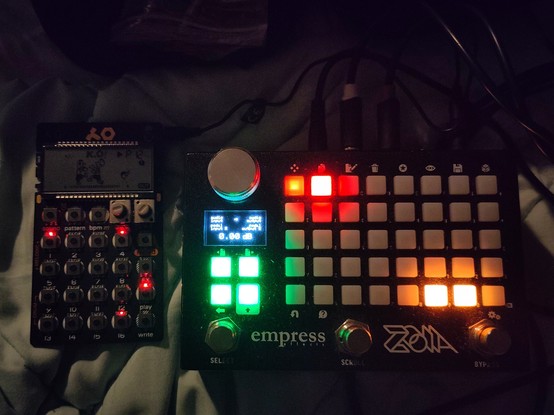
Day 1 - gathering cables
After spending too much time chasing disability-related stuff, I'm feeling pretty dispirited and tired today. I kept the patching simple, just getting things out of the carry case and retracing steps 1-8 of True Cuckoo's ZOIA Mega Tutorial. Pocket operator to audio in, patched to audio out.
Very grateful to my past self for putting all the cables I need for this activity in one place! I forgot that I've actually got the connectors here to plug in the two microphones that are set up at my piano, so that might be a reasonable thing to try to play with this week.
I remember getting quite a bit further along than this before, with at least two pages of glowing lights, so hopefully I'll feel my way back there tomorrow. My old patches are probably still stored here somewhere, but I'm keen to rebuild rather than just review.
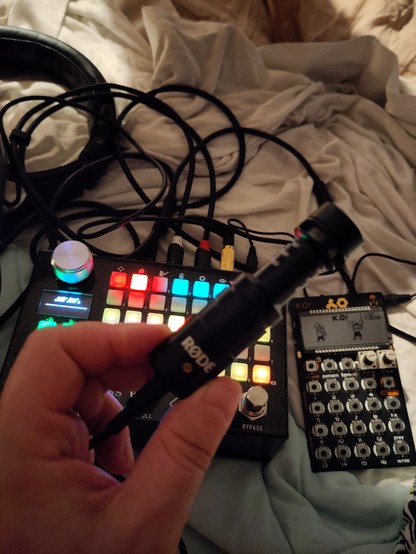
Day 2 - friction
I forgot how GOOD the ZOIA feels to touch. If only all my devices were designed to be stomped on.
I've now retraced my steps to one of the places where I got stuck before: microphones. The RODE mini shotgun mic is the first one I had to hand, which I normally use with a very cheap USB interface at my big computer - not at all what it was designed for, and honestly I'm never entirely sure whether it's working or whether the webcam mic is being used instead. Anyway, without an interface nothing is coming through from it at all.
I know mics are supposed to be amplified, and I recall using my TASCAM DR-40 field recorder's phantom power mode + line out for this purpose when capturing sound from the piano. There's something deeply unsatisfying about it though, and if I'm just looking for an easy way to put mouth noises into the stomp box maybe I should just use the internal mics of the field recorder for now.
Doing this is a LOT of fun. Just growl into the fur and get it back with gain and reverb. I could do this all day. But if the field recorder is the mic, who's recording the audio? That will have to be the phone. And here's another place I always get stuck: making the USB mic / headphones splitter work on my phone so that I can record video while capturing audio from the noisemakers. This is the uninspiring morass that got me bogged down last time.
And here's the kicker: the RODE shotgun mic isn't meant for any of this, it just happens to be here. This mic is specifically for video, and is meant to be powered through the connection on a digital camera. I risk damaging it if I fuck up this preamp malarkey, which I'm likely to do if I follow the admittedly very charming suggestion of building a cheap one from a DIY kit. Also, when looking up this mic I realised that it's not as cheap as I remember, and it should probably be thrown down the sacred well sold on eBay to pay for my disability costs.
Something very fun is tantalisingly close! I'll raid the drawers and boxes tomorrow for things that might allow me to sing into the ZOIA while also recording the results.
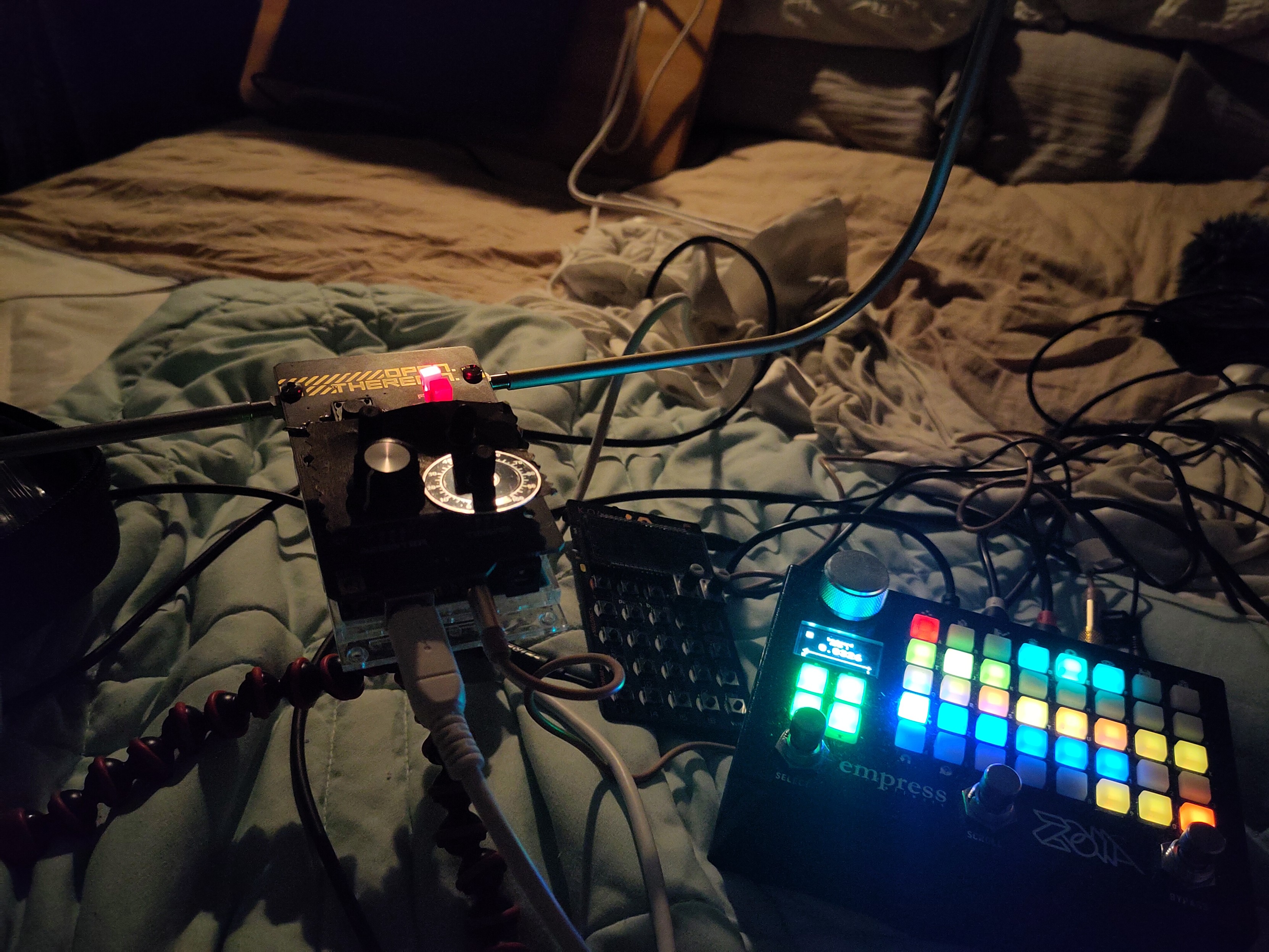
Day 3 - Theremin
I got to the bit in Cuckoo's tutorial where he brings in a midi instrument, and this prompted me to get the Open Theremin out. I did the midi mod on it several years ago, but oddly I don't seem to have the right cable to connect the midi port to the ZOIA. I abandoned the tutorial and went ahead with normal audio input from the theremin, and found that onset detection and pitch detection are actually very easy and useful? I would like to have the option of using volume level (or left antenna distance in general) as well, and wasn't able to find that. I can imagine that a lot of interesting options would open up if I got midi working, but I should probably avoid getting bogged down in faff or buying new cables.
I figured out how to use analog input from the theremin to control the pitch of an oscillator and the onset of a VCO, which was good practice when it comes to patching between the devices though probably not super useful in itself - what I really need is literally any understanding of subtractive synth, because I am no better able to improve the sound of the ZOIA's simulated oscillator than I am the OpenTheremin's.
OR, I could continue to bypass that problem using the PocketOperator's sampling and sequencing ability. Using pitch detection on the theremin analog signal and pitch shifting the sound from the PocketOperator turned out to be very fun, and it has unexpected filtering effects as well. Using the theremin to alter the PocketOperator in this way is very satisfying, and sometimes sounds like something a person might do on purpose!
In any case, this setup on my bed does not allow for intentional melodic operation of the theremin, as there needs to be a lot more space around the antenna to ensure that the magnetic field is large enough to hold an octave in your hand. So focusing on the theremin as a tool for modifying other sound sources might make more sense in the current scenario.
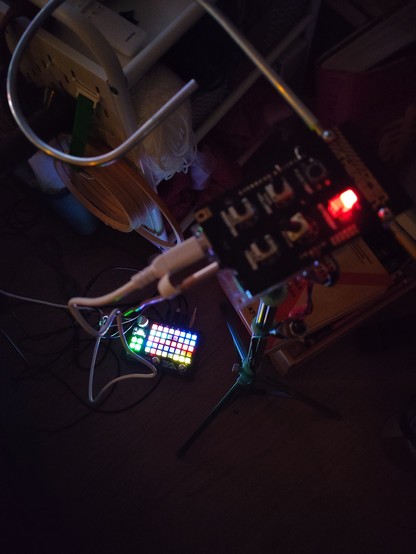
Day 4 - Stompable
I found the midi cable I needed! This did indeed lead me to get bogged down in faff though, with none of the desired results. I got very frustrated trying to modify the Theremin through the Arduino IDE, as the code is not the easiest to navigate (I've been spoiled over the last few years by working with Squinky, who writes very readable code). I ran into permissions issues that made it impossible to write new code to the Theremin, and discovered that for some reason the button is no longer working (the wonky potentiometer is completely fine though!) which is why calibration was not happening. It also means the Theremin has no pause button anymore, which is just great. Eventually I managed to move some code around so that it always calibrates on startup, but I still have no solution for the constant screaming.
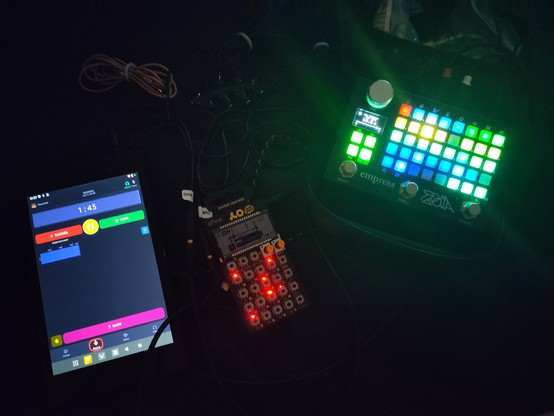
The important thing is, I might with practice be able to make intentional melodies, because the theremin is finally calibrating correctly. Once this was sorted, I started to have fun. I created a patch that allows me to slam one of the pedals to set the pitch of an oscillator to the pitch of the theremin, and then play on top of it. This involved learning a couple of new things on the ZOIA: using a pedal to turn a patch connection on and off, altering the frequency of an lfo using an on-board "keyboard", and somehow, getting lovely transitions through a ping pong delay effect.
Day 5 - sequencing and recording
My de-Googled Nexus 7 is serving as a recording device... Of sorts, at least. The quality is bad (not to knock the Soundtree app, this is a hardware/user issue), but it's no worse than the source material deserves at this point!
Today I explored using an envelope follower to keep time with the pocket operator, and using a sequencer to change the pitch of an oscillator, to produce a bass line with key changes. I'm not following the tutorial right now but this feels like a very obvious beginner task for building confidence!
I also used the envelope follower to pan the audio from the pocket operator, which essentially just like like different percussive sounds coming up in different parts of my head. Unfortunately, I don't think you can experience this in the recording, though I had hoped I'd be able to record in stereo
Day 6 - loopers!
Looping was one of the main features that attracted me to the ZOIA, and I was never able to get my head around it before. I was so ready to make this complicated today as I did years ago. However, it turned out that using the looper module on the ZOIA is actually very simple: all you have to do is change almost all of the defaults when you put in the module lol. I followed the first part of Ron Cavagnaro's tutorial on using the ZOIA as a loop pedal via Matrix Synth's blog, which clarified some basics that I hadn't been able to grok just by poking the thing by myself.
I started out with a few layers of loops, and struggled to keep them in sync. I strongly suspect that this can be handled with a separate module patched to the play button of all the loopers, but there's a much easier solution - just turn on "overdubbing" and keep layering over the same loop. The downside of this is that you have to roll with the punches, a bad take will enter the loop until you erase everything and start from scratch. But it's very quick and creative. I'm probably going to play with it a lot.
So actually, not a lot of patching today! I didn't even save the patch because it was just audio in - looper - reverb - audio out. No theremin today, just voice in through the field recorder. Output recorded through the Nexus 7.
Organising pages of patches
I envisaged that the final day would be a synthesis of some of the things I've tried out this week, but my chronic illnesses were flaring and I wasn't physically well enough to do theremin stuff - aside from the physical strength it takes to sit upright or stand to play it, I somewhat feared getting caught up in midi tech again. Instead, I focused in on the sequencer module, as I've been curious to see how elaborate it can get - can I painstakingly program in entire dungeon synth compositions? The maximum length of a sequence is quite a constraining factor, so I was only really able to get the first half of the opening riff of Nightfall in. If it was just a little longer, I wouldn't mind just setting a bunch of pages with different sequencing patterns and setting up some other module to time the changes between them.
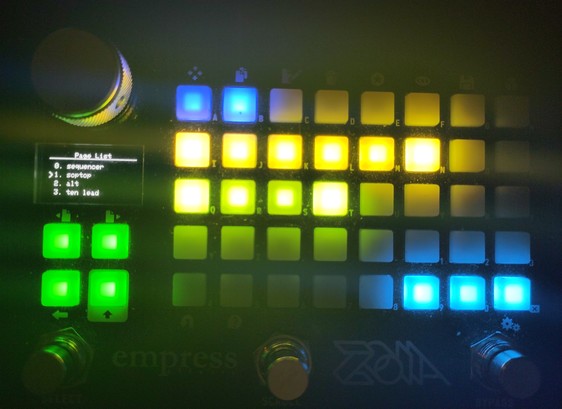
This did push me to patch in more modules, and to think about the way I organise pages of patches. I picked up some possible rules of thumb:
- Page 0 is an interface page. In this case, the sequencer, the LFO that times it, and the audio out are all located on page 0. A mixer might be a good idea here.
- Subsequent pages all conclude with a vca that takes all desired outputs from that page, and sends them to the audio out on page 0. Or they could go to a mixer on Page 0, but in this instance I was pleased to be able to tap though the pages and control each vca in its context.
- On this occasion, the sequencer tracks are colour coded to correspond to their respective oscillators, each of which have their own page with its own effect modules leading to their vca.
Also, it turns out I'm still not over Portal.